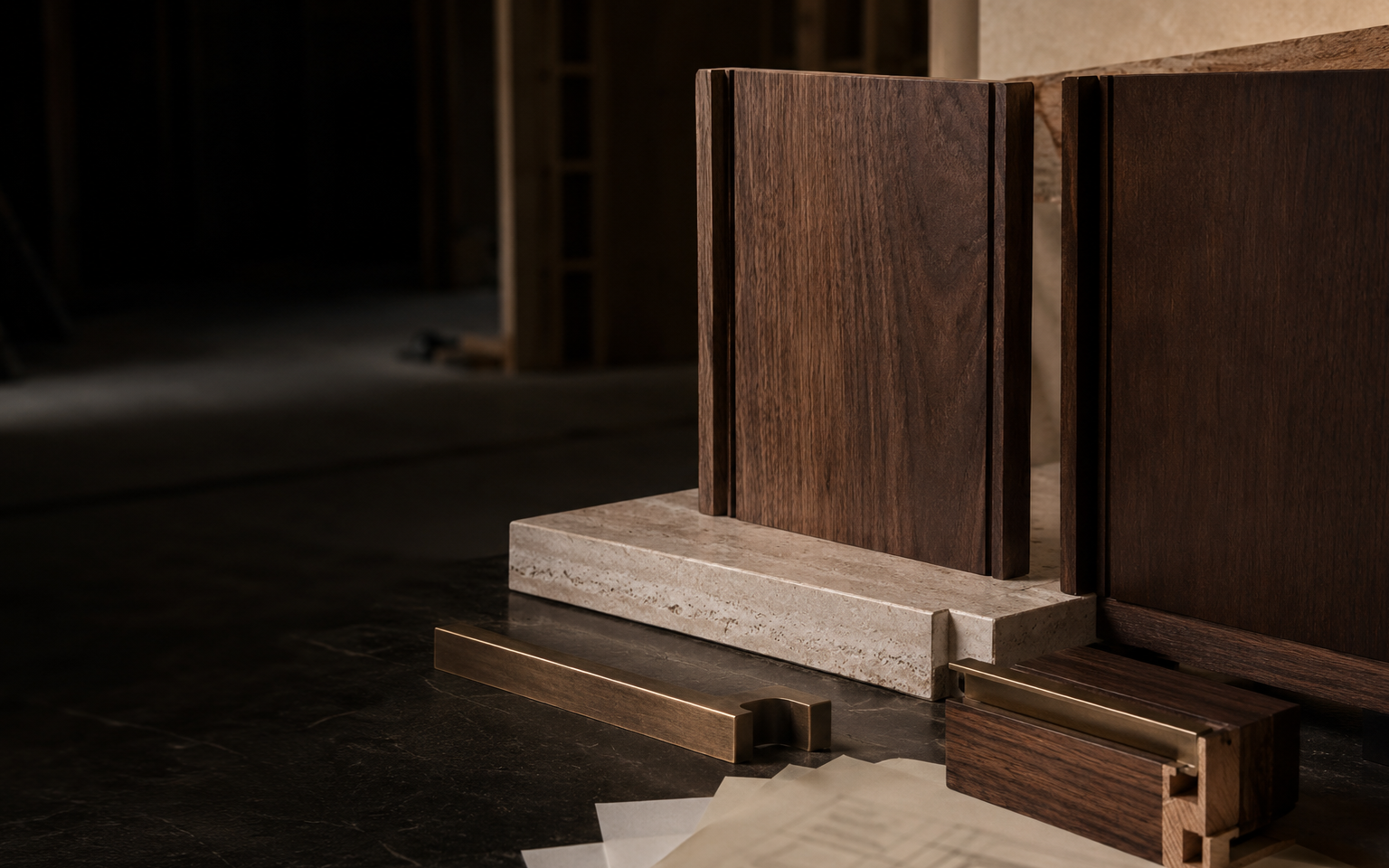
I never approve a substitution as an isolated purchase. I make the team redraw its consequences through design, scope, price, fabrication, installation, and ownership before the project accepts it.
A substitution is often presented as a small answer to a local problem: this material is available sooner, this fitting costs less, this appliance is in stock, this fabricator can start now. But an interior is a connected system. Change one element and the room begins asking new questions.
The Law
Every substitution redraws the room. I treat a change in material, hardware, appliance, finish system, fabricator, or installation method as a design and execution decision—not as a purchasing convenience.
The proposed item may fit the original allowance and still fail the original obligation. Its dimensions, tolerances, substrates, lead time, warranty, sheen, weight, service access, fastening, sequencing, and adjacent interfaces can all be different. Until those consequences are redrawn and reassigned, the substitution is not approved. It is merely suggested.
If the team cannot trace what a substitution changes, it has not priced the substitution. It has only priced the new object.
Why It Matters
Luxury interiors depend on relationships that are easy to miss when decisions are reviewed one line item at a time. A new appliance changes panel geometry, ventilation, electrical location, service clearance, and cabinet engineering. A different veneer changes grain sequence, sample approval, finishing behavior, yield, and replacement risk. A new concealed hinge can alter door thickness, reveal, boring pattern, opening angle, and the blocking behind the cabinet.
Owners do not experience the substitute as an isolated product. They experience the new shadow line, the delayed room, the altered finish, the service panel that will not open, or the change order that appears after installation has already begun. That is why I judge substitutions by their effect on the finished condition, not by the attractiveness of the replacement alone.
The Failure Pattern
The pattern usually begins with a real constraint: price, availability, lead time, discontinued material, or vendor capacity. The team needs relief, so the substitute is compared to the original item by description and unit cost. It looks close enough. Someone marks it approved, procurement moves, and the project celebrates a problem solved.
Then the unpriced consequences surface in separate places. The shop drawings still show the original condition. The electrician has already roughed in. The installer priced a different fastening method. The sample is approved under different lighting. Freight arrives out of sequence. Because each consequence lands in another person’s scope, nobody sees the full cost until the field forces the team to reconnect it.
- The substitute is compared as a product, not as an assembly.
- The purchase price is evaluated without redesign, coordination, or rework.
- Original drawings remain in circulation after the decision changes.
- Schedule relief in procurement creates delay in fabrication or installation.
- Approval is recorded, but ownership of the consequences is not.
The Principle in Practice
I require a substitution map. It is a focused review of everything the proposed change touches before approval becomes a commitment. The map begins with design intent and ends with the installed, serviceable condition. It identifies which drawings change, which samples must be remade, which trades are affected, what cost is added or removed, what dates move, and who accepts the revised obligation.
This does not need to become a committee exercise. A strong substitution review can be concise because it asks disciplined questions in the right order. Is the visual result equal? Is the technical performance equal? Does the geometry still coordinate? Is the full installed cost understood? Does the schedule improvement survive engineering, approval, production, freight, and installation? Has the revised information replaced the old information everywhere it matters?
- Compare complete performance, not marketing descriptions.
- Redline every affected plan, elevation, section, schedule, and shop drawing.
- Reprice coordination, tooling, freight, installation, and adjacent trade work.
- Review a physical sample or mockup under the project’s controlled light.
- Issue one documented decision that supersedes the original condition.
The CEO’s Move
When a substitution reaches me, I ask one question first: ‘What else does this change?’ I keep asking until the answer reaches the field. That question prevents a procurement decision from quietly becoming an owner problem.
If the substitution genuinely protects the project, I want it approved quickly and completely. I align the designer’s visual decision, the architect’s technical record, the general contractor’s scope and schedule, the fabricator’s engineering, the installer’s method, and the owner’s commercial consequence. Then I remove the superseded information from circulation. Speed comes from closing the loop, not from skipping it.
If the replacement saves money in one contract but creates more cost, delay, or design compromise elsewhere, I show the complete trade before anyone calls it value. The owner may still choose it. My responsibility is to make sure the choice is informed, visible, and attached to the real outcome.
Final Rule
A substitution is not equal because the catalog says it is comparable. It is equal only when the finished room, technical performance, schedule, cost, and accountability remain deliberately controlled.
Redraw the consequence before you approve the change. If the team substitutes the object without substituting the information around it, the field will finish the redesign—and the owner will finance it.
COREFINISH GROUP connects design intelligence, technical coordination, qualified makers, and field execution to protect exceptional interiors.
Begin a Private Consultation