
I match the delivery model to the project risk. Craftsmanship matters, but capacity, documentation, field readiness, and accountable coordination determine whether that craftsmanship reaches the project on time.
Most millwork bids look comparable when they first reach a GC’s desk. Both may list cabinets, counters, trim, delivery, and installation. The real difference appears after award: in engineering capacity, shop drawings, production redundancy, schedule recovery, field coordination, and the ability to absorb change without losing control.
Compare the delivery model—not a stereotype.
Small shops can deliver outstanding craftsmanship and strong project management. This is a comparison of operating models and risks to evaluate, not a statistical claim that 80% of shops underperform. Actual capacity, quality, lead times, and recovery options must be checked for every supplier and project.
All six images in this report are AI-generated editorial illustrations. They do not depict actual partner factories, personnel, products, or completed COREFINISH projects.
The cheapest millwork number is not the lowest project cost when the GC must supply the missing coordination and carry the schedule exposure.
The reality of the typical small shop
Independent cabinet and millwork shops can deliver excellent work, especially on projects that match their normal size and complexity. Their strength is often personal attention and hands-on craftsmanship. Their limitation is structural: the owner, estimator, project manager, purchasing lead, problem solver, and sometimes installer may be the same person.
That concentration works until several jobs collide, an approval arrives late, material is backordered, field dimensions change, or another customer needs the same crew. A GC may believe it bought a complete subcontract, but it may have actually bought the available attention of a small number of people.
Capacity: Production depends on a limited floor, limited equipment, and a small labor pool. One delayed project can consume the space intended for the next.
Owner dependency: Decisions can stop whenever the owner is estimating, installing, traveling, or resolving another emergency.
Estimate-to-production gaps: The estimator’s assumptions may never become a formal production package, leaving scope decisions to be rediscovered in the shop or field.
Shop drawings: Engineering may be outsourced or handled after award as capacity allows. Late drawings become late approvals; late approvals become compressed fabrication.
Installation manpower: A capable shop crew is not automatically a scalable field force. When the schedule slips, adding qualified installers may be difficult or impossible.
Specialty scope: Acoustic panels, complex feature walls, specialty finishes, solid surfaces, and engineered assemblies may fall outside the shop’s core workflow and require improvised coordination.

The COREFINISH network changes the delivery model
COREFINISH does not treat every package as if one fabricator must be the best answer for every condition. We organize the work around capability. Scalable casework, custom architectural features, acoustic treatments, countertop packages, logistics, and field installation can be assigned to the resources best suited to each component—while the GC maintains one coordinated point of control.
TMI Systems Corporation publishes casework, architectural woodwork, and countertop offerings. Northway Industries Inc. describes contract manufacturing for laminate casework, components, countertops, and related millwork. COREFINISH coordinates these resources according to the project’s needs, accepted scope, and confirmed vendor commitments.
The acoustic-panel resource identified for this network is Univicoustic (apac-middleeast.univicoustic.com). Product selection requires current technical data, fire-performance documentation, acoustic test information, mounting details, availability, and project-specific approval. No performance rating or guaranteed lead time is implied.
Manufacturer references: TMI Systems product offering — tmisystems.com/products/product-types/; Northway Industries contract manufacturing — northwayind.com/aboutus.php. Network participation does not imply exclusivity, unlimited capacity, or an automatic substitute for a project-specific commitment.
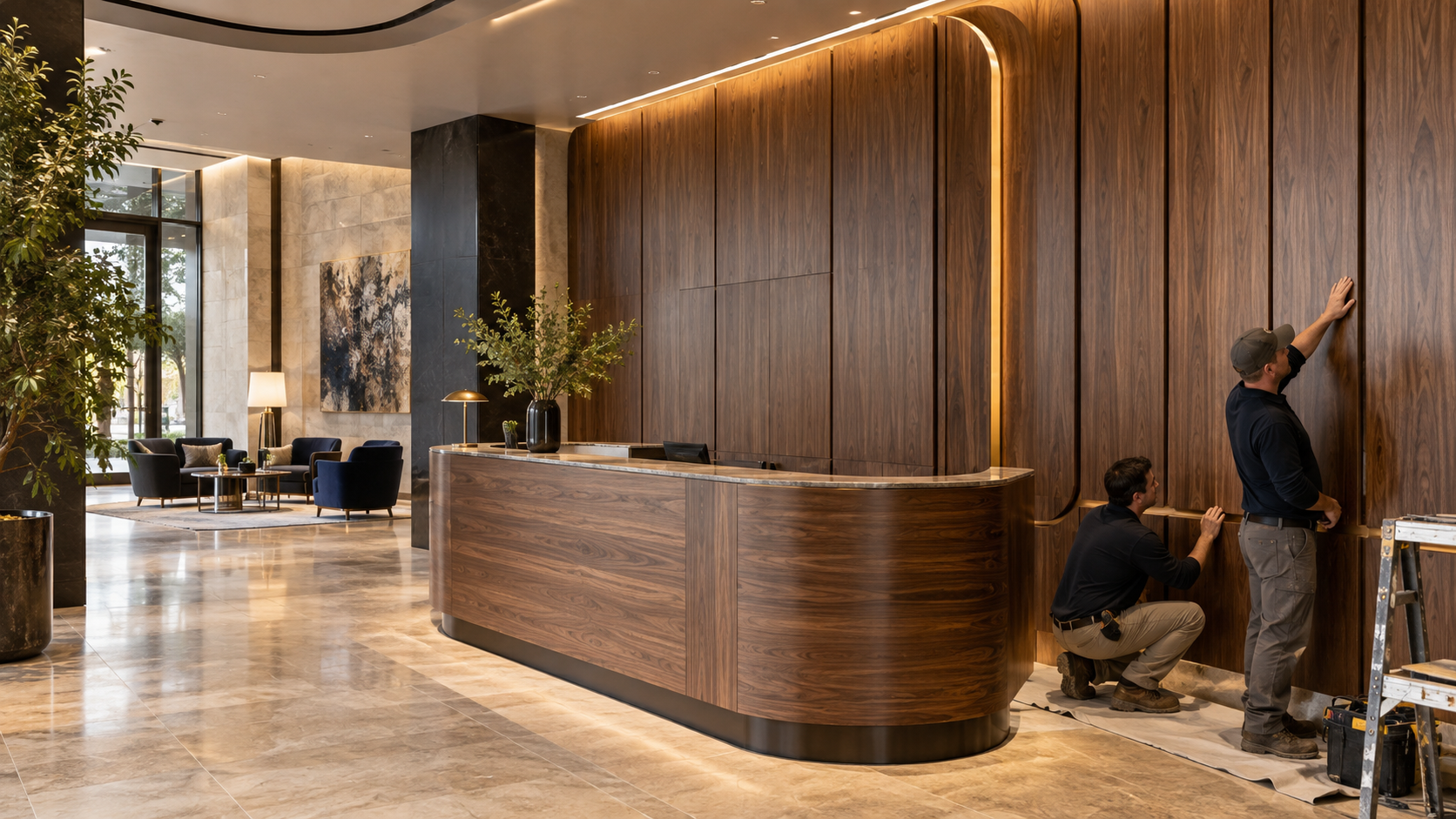
One project, multiple capabilities, one control point
The benefit is not merely having more vendor names. A loose collection of vendors can create more coordination risk. The value comes from an active control layer that carries intent from plans through closeout.
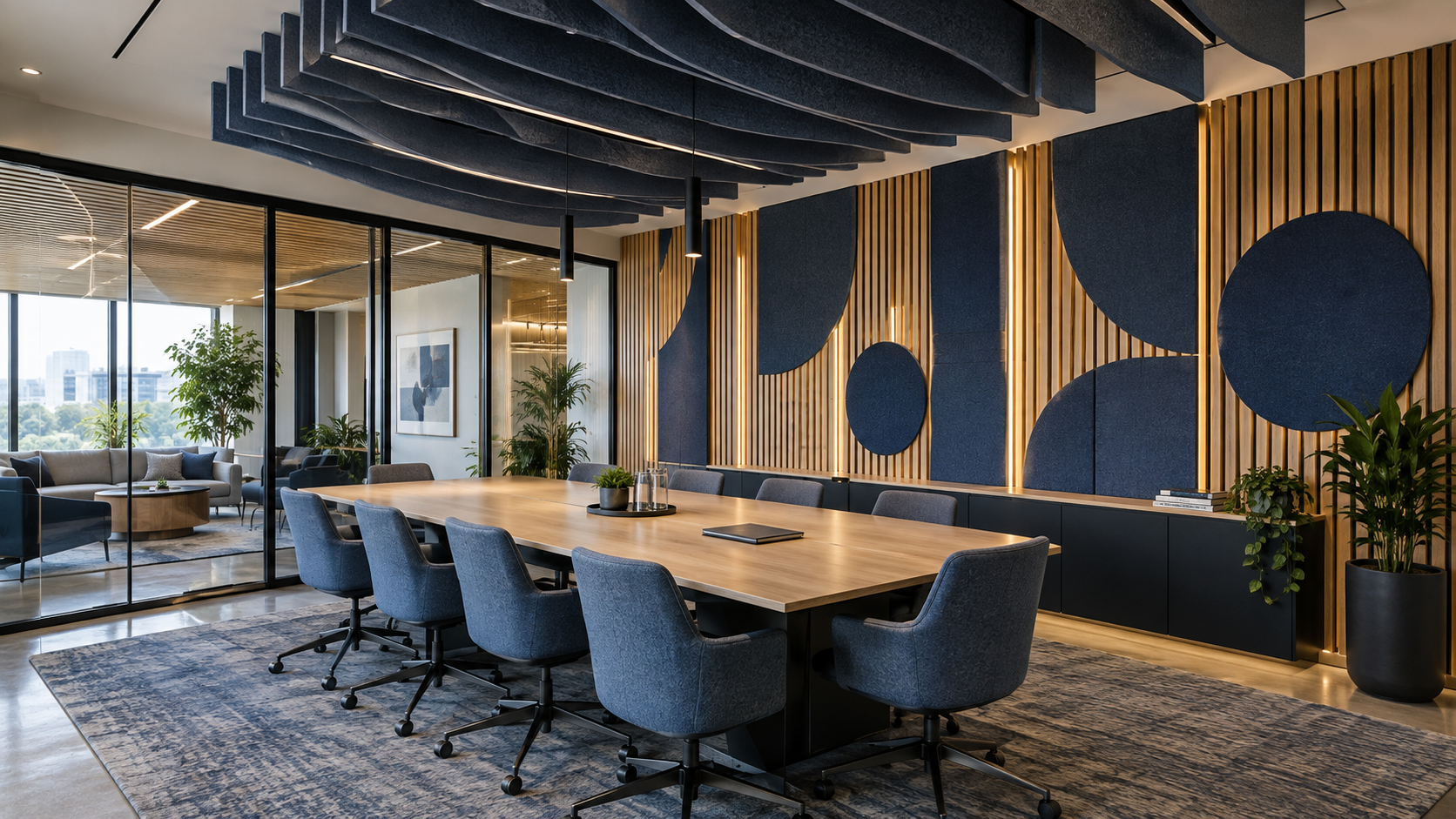
- Scope control: break the documents into measurable assemblies, identify exclusions and allowances, and close gaps before they become field arguments.
- Submittal control: track required selections, shop drawings, approvals, revisions, and release dates against the construction schedule.
- Procurement control: match each product to a capable source and monitor materials that can dictate the critical path.
- Production control: confirm that approved information, materials, capacity, and promised completion dates align.
- Field control: coordinate verification, delivery sequence, storage, installation readiness, punch, and closeout.
Side-by-side: what the GC is actually buying
| Project factor | Small-shop model: risk to evaluate | COREFINISH network approach |
|---|---|---|
| Capacity | Limited to one shop’s floor, equipment, and current backlog | Work matched to scalable and specialty capabilities |
| Redundancy | Key-person and single-facility dependency | Multiple qualified resources coordinated through one control layer |
| Estimating | Often experience-driven with assumptions held by individuals | Documented scope, allowances, risk flags, and measurable bid basis |
| Shop drawings | May compete with production and field demands | Managed as a scheduled release requirement |
| Procurement | Purchasing reacts to approvals and cash flow | Long-lead items and release gates tracked intentionally |
| Schedule recovery | Limited ability to add engineering, production, or installation capacity | Network resources allow targeted recovery planning |
| Specialty scope | May be excluded, improvised, or subcontracted without integrated control | Custom millwork and acoustic packages coordinated with the core interior work |
| Installation | Often tied to the same people supporting the shop | Field manpower, logistics, sequencing, and readiness managed separately |
| Documentation | Decisions may live in calls, texts, and personal memory | Approvals, assumptions, revisions, and status maintained as a controlled record |
| Accountability | The GC coordinates gaps between fabricator, specialty vendor, and installer | COREFINISH owns coordination across the package |
The biggest factor is schedule slippage
Quality failures are visible. Schedule failure is more expensive because it spreads. Millwork often sits near the end of the project, after layout, utilities, walls, ceilings, flooring, and owner selections. When it slips, there may be no float left to absorb the delay.
A late approval does not simply move fabrication by the same number of days. It may miss a material order, a production opening, a freight window, or the installer’s committed slot. The result is cascading delay: a two-week decision gap can become a much larger field impact.
The cheapest millwork number is not the lowest project cost when it requires the GC to supply the missing management, carry the schedule exposure, or recover work that the original shop can no longer staff.

How a GC can prevent the common failure pattern

- Prequalify capacity, not just craftsmanship. Ask what is already in production during your required window and who performs engineering, purchasing, project management, and installation.
- Require a dated submittal and release plan. Tie drawings, selections, approvals, field verification, production, delivery, and installation to the master schedule.
- Separate confirmed scope from allowances. Unknowns should be visible, priced intentionally, and assigned an owner and resolution date.
- Validate field readiness before release. Do not manufacture from a coordination set when final conditions depend on measurements or adjacent trades.
- Track evidence. Record what drawing, detail, finish, or written direction supports each major assembly and price decision.
- Plan recovery before it is needed. Know what production, shipping, and installation alternatives exist if the critical path changes.
When a small shop is still the right answer
A strong local shop can be the right choice for a modest, well-defined package with complete drawings, flexible timing, limited specialty coordination, and manageable field conditions. The point is not that small shops are inferior. The point is that their operating model must match the risk profile of the project.
Large, phased, occupied, schedule-critical, multi-location, or technically mixed projects require more than fabrication skill. They require a delivery system.
The practical difference
With a typical small shop, the GC may be buying cabinets and relying on the shop to stretch into project controls. With COREFINISH, the GC is buying a coordinated commercial-interiors delivery structure: capability matched to scope, decisions documented, risks surfaced, schedule gates managed, and field execution tied back to the accepted basis.
The deliverable is not merely millwork. It is controlled responsibility from plans through punch.
Commercial millwork without fragmented accountability
For general contractors who need scalable casework, custom architectural millwork, acoustic treatments, procurement coordination, field inspections, and installation oversight organized around one controlled record.
COREFINISH GROUP connects design intelligence, technical coordination, qualified makers, and field execution to protect exceptional interiors.
Begin a Private Consultation