
Before I call a material package secure, I want the approved scope, supplier acceptance, payment allocation and release status to tell the same story. The project deserves evidence behind the promise.
The check cleared. The materials did not get ordered. Somewhere between payment and production, your project became exposed to a business problem you could not see. A better payment structure makes the obligation visible before the schedule depends on it.
AI-generated editorial imagery illustrates planning, not an actual client project. All financial examples in this edition are hypothetical.
The check cleared. Did the order?
The owner has funded the payment. The general contractor has processed the application. The subcontractor has acknowledged receipt. Everyone can point to a transaction. Then someone asks the supplier for a delivery date—and discovers that the required deposit has not arrived.
That is the moment a project learns the difference between paying an invoice and securing an obligation. The paperwork says money moved. The purchasing record may tell a different story.
Consider a hypothetical subcontractor trying to close out an older job while starting yours. An overdue supplier balance, payroll shortfall or rework bill creates pressure. Your deposit becomes available cash before your order becomes a funded commitment. This is a risk scenario, not an allegation about a particular contractor or a claim that all bundled contracts operate this way.
Ordinary business cash management is not, by itself, evidence of wrongdoing. Contract duties and applicable law matter. The operational concern is specific: money intended to advance your purchasing package has not produced the promised purchasing progress.
A paid invoice is not proof that your materials are secured.
Your project should not become the rescue plan for another one.
A delayed material order can affect more than the trade that placed it. Cabinetry holds up countertop templates. Countertops affect plumbing completion. Equipment interfaces remain unresolved. Inspection, turnover and occupancy planning begin to depend on a purchase that everyone thought was already secure.
There may be an explanation other than cash diversion: incomplete approvals, a credit hold, an unresolved finish, a supplier capacity problem or a scope dispute. Treat a missing release as an exception to investigate, not an accusation to publish.
The GC needs a documented answer while there is still time to act: What was ordered, what was paid, what has been accepted, and what will actually ship? A request to “trust the process” cannot substitute for those records.
Change the route of the money—and keep the evidence.
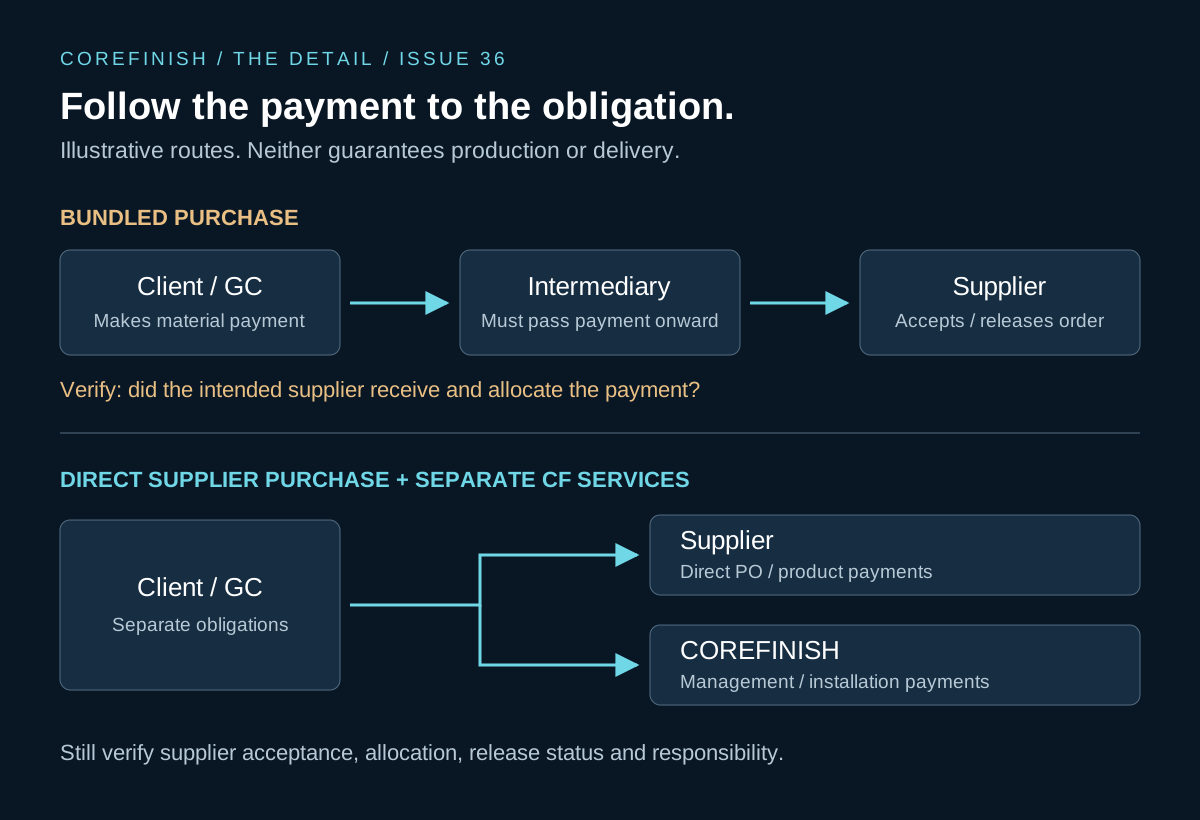
Under COREFINISH’s direct-purchasing structure, the client or GC issues the supplier purchase order and pays the supplier directly. COREFINISH contracts separately for procurement management and installation. Supplier material funds therefore do not need to pass through CF’s operating account.
That removes the CF pass-through step for those supplier payments. It does not establish that the supplier has segregated the money, reserved materials or protected them from insolvency. Direct payment changes the payment path; supplier qualification and purchasing controls still determine what that payment secures.
The operating record should connect each disbursement to a named project, approved scope, supplier acknowledgment, invoice and allocation. Independently verify the supplier’s payment instructions through a known contact before an initial payment or a bank-detail change.
A $100,000 package. Three different obligations.
Consider an entirely hypothetical $100,000 interiors package: $70,000 in supplier purchases, $12,000 in procurement management and $18,000 in installation. The CF service contract is $30,000; the client’s separate supplier commitments total $70,000. These figures are an illustration, not a published client price or an industry benchmark.
Suppose an agreed $35,000 supplier deposit is due. In a bundled arrangement, the GC may need evidence that the intermediary passed that amount to the correct supplier. Under a client-issued DPO, the GC pays the supplier against its accepted order and obtains acknowledgment of that payment.
The same $35,000 has been paid. What changes is the route and the GC’s direct visibility into the transaction. Neither route alone proves fabrication has started. The next evidence is the supplier’s written release status and supported production commitment.
| Component | Payment recipient | Illustrative amount |
|---|---|---|
| Products and fabrication | Supplier, under client/GC purchase order | $70,000 |
| Procurement management | COREFINISH under service agreement | $12,000 |
| Installation | COREFINISH under installation scope | $18,000 |
| CF contract value | Management plus installation only | $30,000 |
| Combined project investment | Supplier commitments plus CF services | $100,000 |
Transparency must include our fee.
If a supplier package costs $24,000 and CF’s procurement and management fee is $11,000, the proposal should identify those amounts separately under a direct-purchasing arrangement. It should not label $35,000 as a direct supplier cost.
Our fee pays for a defined obligation: scope reconciliation, supplier coordination, purchasing administration, shop-drawing coordination, production tracking and delivery planning, as contracted. We must identify those deliverables and avoid adding a second fee for the same work.
A quoted management fee is not automatically a percentage of supplier cost. The proposal must state whether it is fixed, percentage-based or estimated, and how approved scope changes affect it. Visibility is useful only when the client can reconcile the total without guessing.
A milestone is a condition, not just a date.
COREFINISH’s standard management schedule is 50% at engagement, 40% when purchasing coordination is complete and approved orders are released, and 10% when the contracted management services are complete. Installation is separately scheduled at 50% before mobilization, 40% at main installation completion and 10% at substantial completion of the installation scope.
Those percentages apply independently to each CF service fee. They do not apply to the total project investment or dictate a supplier’s deposit requirements. Supplier payments follow its accepted purchase order.
The engagement and mobilization payments remain advances against defined services. They are not escrow, and a percentage schedule alone does not ring-fence funds or prove performance. The signed agreement must define deliverables, milestone evidence, acceptance and the handling of incomplete work.
A strong payment schedule makes the next obligation explainable. For example: approved drawings identified by revision, supplier order acceptance recorded, open exclusions resolved, and a field area accepted for installation. A calendar reminder cannot establish those facts.
Joint checks are a different tool—not a synonym for a DPO.
A joint check names two payees, commonly a subcontractor and its supplier, and requires the corresponding endorsements. AIA Contract Documents describes joint checks as a way to improve payment visibility and reduce reliance on an upstream party to distribute funds. It also notes that use depends on the contract and governing law. [1]
A DPO puts the supplier purchase contract with the client or GC. A joint check can support an arrangement in which the subcontractor remains the purchaser. The distinction affects purchasing authority, accounting and responsibility; the check itself does not rewrite those obligations.
Agree the invoices, project allocation, amounts, endorsements and payment-application credits before use. AIA warns about unintended obligations; AGC’s joint-check handout likewise stresses careful written arrangements. Have project counsel confirm the mechanism fits the signed contracts rather than assuming a second name on a check resolves every issue. [2][3]
Direct purchasing moves responsibility as well as money.
The client becomes the supplier’s purchaser for the direct order. The project must decide who approves changes, receives shipments, checks damage, arranges storage, pursues warranty claims and handles cancellation. CF’s coordination scope must match the authority it has actually been given.
Before release, establish when title and risk of loss transfer, what insurance applies, and how off-site materials are identified, protected and inspected. A paid deposit is not automatically proof of ownership or an enforceable right to retrieve materials.
Supplier failure, inaccurate specifications, missed lead times, freight damage and incomplete installation can still happen. DPOs and joint checks do not automatically eliminate lien exposure, override lending requirements or replace appropriate insurance and bonds. Contract and jurisdiction-specific protections need separate review.
The goal is fewer unexamined assumptions. A clearer payment path should come with a clearer responsibility map—not an empty space where accountability used to sit.
Before the next release: the GC and owner checklist.
Use the following as a payment-release brief for the project team. Record evidence, an accountable person and the next action for each item. An unresolved item needs a decision before the team treats the corresponding commitment as secure.
- Identity: independently confirm the supplier, authorized contact and payment instructions.
- Scope: match the quotation and PO to current drawings, quantities, finishes and exclusions.
- Amount: distinguish a confirmed quote from an allowance; show applicable freight, taxes and adjustments.
- Authority: identify the legal purchaser and who may approve changes or cancel an order.
- Allocation: identify the project and invoices covered; require acknowledgment of where payment was applied.
- Release: obtain order acceptance, required approvals and a supported production/release status.
- Materials: verify identification, storage, inspection access, title/risk terms and insurance where relevant.
- Delivery: assign unloading, access, receiving inspection, protection and damage reporting.
- Reconciliation: credit direct or joint payments once; update the contract and payment application consistently.
- Completion: define management and installation milestones, remaining punch items and closeout evidence.
If supplier pricing is not ready, show the allowance.
A bid deadline does not always leave time for a final supplier quotation. It is reasonable to issue a proposal with an identified supplier budget allowance. It is not reasonable to make that estimate look like a confirmed vendor commitment.
State what the allowance covers, its estimating basis, who will confirm it and what happens if the final quotation changes. Keep management and installation fees separate and identify whether each is fixed or estimated.
Before ordering, reconcile the final supplier amount and obtain written approval for any change to the project budget. A clearly labeled allowance keeps the bid moving while preserving the decision that still needs to be made.
When the payment story stops matching the production story.
Warning signs deserve prompt verification: repeated deposit requests without updated order records; a supplier that cannot identify the project; an unexpected change in bank instructions; or a delivery promise unsupported by accepted drawings and production status. None is conclusive proof of diversion.
Ask for a project-specific reconciliation of commitments, payments, credits and remaining balances. Contact the supplier through a verified channel. Document which release conditions remain open and escalate through the agreed project procedures.
If the records do not reconcile, involve the responsible commercial leadership and relevant lender, surety, insurer or counsel as appropriate to the project. A new disbursement should have a verified purpose and authorization. Another promise should not become the only control.
Pay for the obligation. Verify the progress.
For GCs and owners, the practical benefit is earlier visibility into a material commitment that can affect the entire completion sequence. For qualified suppliers and installers, clear scope and funding responsibilities support realistic commitments instead of hidden financing pressure.
COREFINISH’s approach separates direct supplier purchases, one defined procurement-management fee and installation services. We connect those agreements through coordinated records, approvals and field planning. The client sees what it is buying, who receives each payment and what must happen next.
Your project should not unknowingly finance someone else’s job. The strongest response is a payment structure that makes the purchasing obligation visible, followed by the discipline to verify it.
Direct purchasing can remove an intermediary’s opportunity to divert the supplier payment at that step. It cannot eliminate every financial or performance risk. That distinction is why a credible system combines payment routing, vendor qualification, written responsibilities and continuing verification.
Explore COREFINISH’s Purchasing & Payment process ↗
References & application
This edition presents COREFINISH’s operating approach and illustrative scenarios. Joint-check guidance is supported by the references below; it does not establish rights under any particular project contract. Confirm legal, insurance and financing requirements for the actual project.
COREFINISH GROUP connects design intelligence, technical coordination, qualified makers, and field execution to protect exceptional interiors.
Begin a Private Consultation